Key Highlights
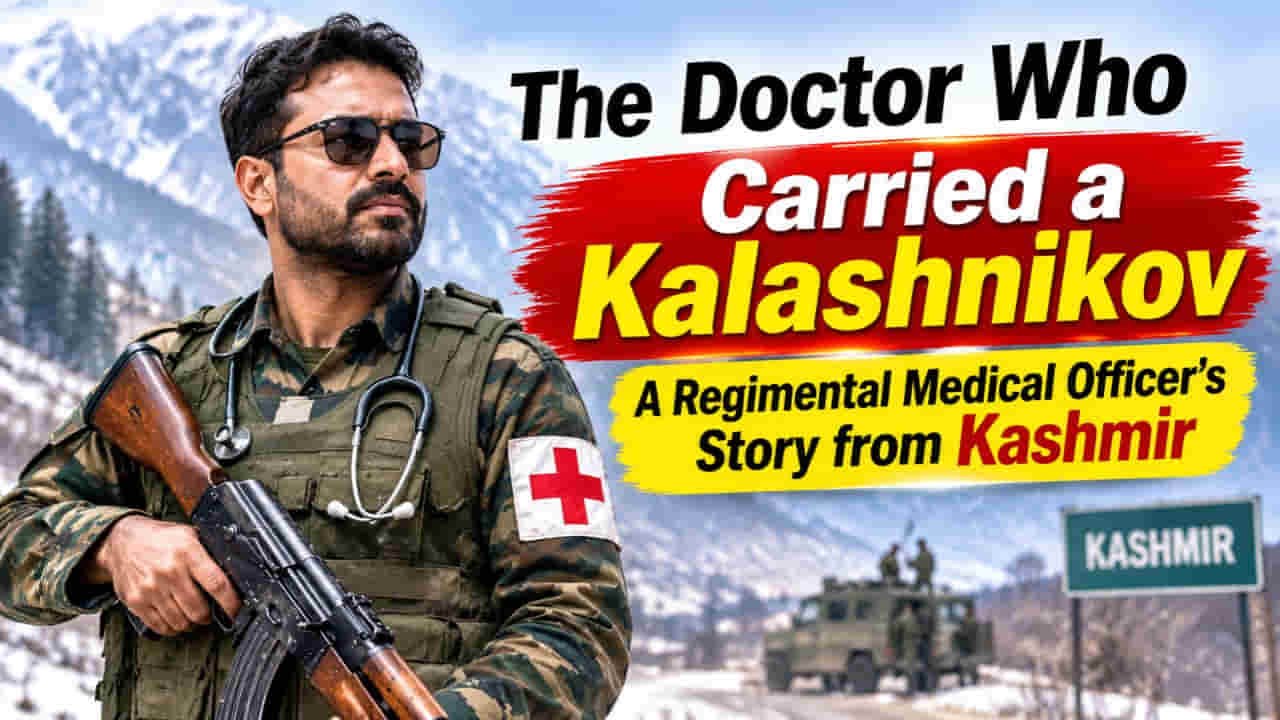
- A young Regimental Medical Officer learns to handle the Kalashnikov before taking up duties in Kashmir's counter-insurgency environment.
- Joins a night patrol beginning at 0200 hours through difficult terrain in the Kashmir Valley.
- Faces challenging conditions during a joint operation, crossing a narrow wooden bridge nearly 20 feet above a river and climbing snow-covered slopes.
- Balances medical responsibilities with the demands of military life, gaining firsthand experience of the challenges faced by troops in the field.
When I began my journey as a Regimental Medical Officer (RMO), I was eager to learn and adapt to my new environment. Gradually, I started understanding the battalion’s working culture, its requirements and the importance of my appointment. I realised that my responsibilities went beyond treating patients. I was also responsible for protecting the health, morale and overall well-being of the troops.
During the initial days, a Havildar instructor was assigned to train me in handling an AK-47. Operating in a counter-insurgency environment required me to be familiar with the weapon and confident in handling it. The instructor made it clear that I would be entrusted with the rifle only after demonstrating the required skills.
I took the training seriously and put in considerable effort to learn. After successfully completing the training, I was finally handed over the Kalashnikov. Feeling proud of the achievement, I reported to the Adjutant and submitted my training completion report.
My First Exposure to a Counter-Insurgency Operation in Kashmir
Soon after completing the training, my Commanding Officer assigned me to an operating base. I was sent there to organise a medical camp and familiarise myself with the area. The location offered a breathtaking view of the valley, but an unexpected opportunity soon turned the visit into an unforgettable experience.
A senior officer asked me whether I would like to accompany him on an operation. I immediately agreed, filled with enthusiasm and excitement. The operation began at 0200 hours. Our team moved through difficult terrain under the cover of darkness. The surroundings were quiet, with only the rustling of leaves and the occasional sound of owls breaking the silence.
During the movement, I faced an unexpected challenge. We had to jump across a naala from a height. While the other members of the team crossed it without difficulty, I froze for a moment and hesitated. The accompanying officer encouraged me to take the jump. Following his instructions, I finally made it across safely.
The patrol continued until morning. However, the terrorists had already fled, and the team returned without achieving its operational objective. Despite this, the experience gave me my first direct exposure to an operation in the Kashmir Valley.
A Difficult March Through Snow-Covered Mountains
Another memorable experience came during a joint operation in the snow-covered mountains. This time, I was wearing a bulletproof jacket and heavy snow boots, with my Kalashnikov in hand. Moving through the difficult terrain with all that equipment was physically demanding.
One of the biggest challenges was crossing a narrow wooden bridge. It was wet and slippery, and the river flowed nearly 20 feet below it. Looking at the bridge gave me goosebumps. The thought of slipping and falling into the river was frightening.
The officer accompanying us suggested that anyone uncomfortable crossing the bridge could sit down and slide across it. I was the first to follow his suggestion. Sitting down, I carefully crossed the bridge and continued with the team towards the mountain base.
Climbing the Mountain With a Kalashnikov
As we reached the mountain base, the snow-covered peaks stood tall around us. Climbing the snowy slope was an exhausting task, especially while carrying a rifle and wearing heavy protective equipment.
Some soldiers came down to help me. They offered to carry my rifle so that I could climb more comfortably. However, I declined their offer and continued carrying my weapon.
After considerable effort, we finally reached our designated location. Unfortunately, the militants had escaped, and the team had to begin its return journey.
While moving downhill, we came across the same wooden bridge again. This time, I crossed it on foot without hesitation. I realised that the darkness and poor visibility during the earlier crossing had probably made the bridge appear more frightening than it actually was.
After completing the movement, I removed my snow boots and noticed that my feet had become macerated because of prolonged exposure to moisture. It was a reminder of the difficult conditions in which soldiers operate in the mountains.
When the Stethoscope and Kalashnikov Became Part of One Duty
Handling an AK-47 while continuing the responsibility of treating soldiers gave me a unique experience. It introduced me to two different but closely connected worlds: that of a doctor and that of a soldier.
As a Regimental Medical Officer, my primary responsibility remained the health and well-being of the troops. The stethoscope continued to define my professional role. However, carrying a Kalashnikov helped me understand the challenges faced by soldiers operating in difficult terrain and demanding conditions.
These experiences in Kashmir taught me that an Army doctor must understand not only the medical needs of soldiers but also the environment in which they serve. The stethoscope remained my calling, but the Kalashnikov introduced me to another world — the world of the soldier whose life I was entrusted to protect.