📍New Delhi | 28 Oct, 2026, 8:09 PM
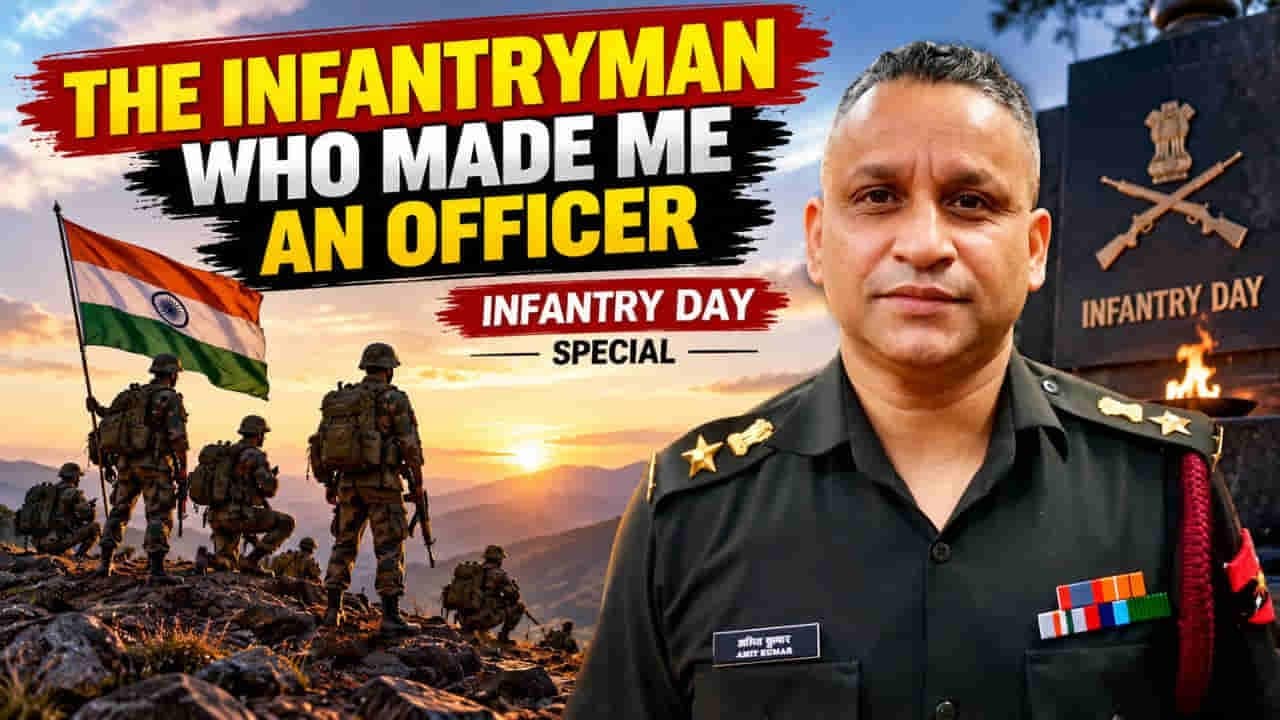
Every year on 27 October, the Indian Army celebrates Infantry Day, commemorating the historic landing of 1 SIKH at Srinagar airfield in 1947. It was a defining moment in the military history of independent India.
But whenever I think of the infantry, my mind travels beyond military operations, battles and gallantry awards. I think of the men who shaped my understanding of a soldier long before I became one myself. My fascination with the infantry began during my formative years, watching my maternal uncle, an infantry officer from 5 RAJPUT.
What a personality he possessed!
A handsome man with a zero haircut, an impressive moustache, immaculate bearing and sense of dressing. I vividly remember him wearing a crisp white full-sleeved shirt, black trousers and a tie. Much later, when I joined the Armed Forces, I became familiar with terms such as lounge suit, open collar and different combinations of service dress. But back then, all I knew was that my maternal uncle looked every inch an officer. His personality extended far beyond his appearance. His stories about his commando training and five years tenure in Sri Lanka, including Operation Pawan, had a profound influence on my young mind. His physical standards were extraordinary. His oratory skills were of such a calibre that even Amitabh Bachchan might have felt compelled to make room for him in the movies! His discipline, moral uprightness and clarity of thought fascinated me beyond imagination.
Beyond his sheer bravado and remarkable clarity amid chaos, he possessed an entirely different, softer side- He played the mouth organ and guitar beautifully. And when he sang Mohammed Rafi or Kishore Kumar songs, his voice could touch one’s heart and soul.
What a complete package he was!
Somewhere during those formative years, I began associating all these extraordinary qualities exclusively with an Infantry officer. Little did I know that the Army would eventually introduce me to another infantryman who would transform that childhood fascination into a lifelong philosophy.
My First Commanding Officer
When I joined my first unit as a Regimental Medical Officer in a newly raised Rashtriya Rifles battalion, I met Colonel Mahender Singh Yadav, my first Commanding Officer. He was an infantryman in the truest sense of the word. One of his earliest lessons to me was about brotherhood. He asked me to replace my Army Medical Corps rank insignia with those of the Rashtriya Rifles, so that the troops would feel a stronger sense of association with their doctor.
It was a small gesture, but the lesson was enormous. He wanted me to understand that although I belonged to the Army Medical Corps, I was also an integral part of his battalion. The soldiers needed to see me not merely as a doctor who treated them, but as an officer who belonged to them. He taught me that leadership was not confined to giving orders, but understanding the smallest details, developing clarity of thought and avoiding shortcuts.
During the Battle Physical Efficiency Test, he insisted that I complete the entire five-kilometre run against the endurance clock, without cutting corners. For him, shortcuts were unacceptable, whether on the running track or in life. He taught me the intricacies of military etiquette, including the customs of the Officers’ Mess and the Adjutant’s office. I still remember an incident when he explained that even the Commanding Officer salutes the Adjutant’s office while entering it, as a mark of respect for the appointment. The Adjutant himself happened to be listening.
When the CO departed, the Adjutant turned towards me, visibly impressed.
“Wow! What a lesson! CO is absolutely right!”
Such was the man. Even his lessons in military etiquette became lessons in institutional respect.
The Doctor Who Had to Become a Soldier
One day, he casually asked me while I was in Adjutant’s Office:
“Doc, what are you doing for your living?”
“Nothing, Sir,” I replied, totally confused as to what to say.
That was enough for him. He sent me out on patrol. Perhaps he believed that an idle young officer was an opportunity waiting to be utilised! He frequently made me undertake foot patrols to different company locations. His reasoning was simple – As the battalion’s doctor, I needed to know the terrain, the routes and the locations intimately. When the situation demanded the evacuation of a casualty, I could not afford to lose my bearings. He taught me how to negotiate mountainous terrain confidently, even walking uphill with both hands in my pockets, unsupported. He shouted at me on the basketball court, pushed me beyond my physical limitations and constantly challenged me to become tougher. At times, I wondered why a doctor needed to undergo so much. But he had already seen something in me that I had not yet discovered in myself.
He never missed an opportunity to take me along as his co-driver when moving out in response to encounters with militants. He trusted me, encouraged my interest in physical fitness and even tried to expose me to the experiences of the Ghatak Platoon.
He was ensuring that the doctor understood the men he was expected to serve. In fact, under his command, I gradually transformed into what I fondly call a “Badmaash RR boy.”
I remember an occasion when the Commanding Officer of another Rashtriya Rifles battalion visited our location for lunch. I had just returned from patrolling, carrying my pitthu, AK-47, magazine pouch and a bulletproof jacket. Add to that my rather impressive beard and moustache, and I must have presented quite a formidable appearance! The visiting CO mistook me for an infantry officer.
I still cherish that moment.
Here I was, a young Army Medical Corps doctor, being mistaken for an infantryman! Had I not served as an RMO in the Rashtriya Rifles, I might never have acquired that unmistakable infantry touch to my uniform. And the credit belonged entirely to Colonel Yadav.
And then came another experience I have never forgotten. On one occasion, when no other officer was available for a long-range patrol, he ordered me to undertake it. I went. When I returned, he looked at me, turned his moustaches upwards in his characteristic style and said:
“Doc! The whole battalion is proud of you!”
Even today, I can recall those words. For a young medical officer, there could hardly have been a greater compliment. He had instilled in me a confidence that no classroom, textbook or formal training course could have provided.
When an Infantryman Chose Wisdom Over Anger
But perhaps one of the most important lessons he taught me was about the art of handling people. I once encountered a problem involving my nursing assistant. Upset by the situation, I approached my Commanding Officer. His initial reaction was furious. At that moment, I saw him almost as a villain. Feeling aggrieved, I took the matter to CO of Field Hosp. What happened thereafter changed my perception of my own CO. Instead of allowing the matter to escalate, Colonel Yadav arranged a meeting between me and CO Field Hosp. He bridged the communication gap and helped resolve the issue. My respect for him increased enormously. I realised that the same infantry officer who could be uncompromising during operations could also exercise remarkable restraint when dealing with a young subordinate.
An infantryman does not need to lose his cool to establish his authority. He knows when to use the sword and when to use wisdom.
That lesson has stayed with me throughout my military career.
The Man Behind the Commanding Officer
His concern for my professional future was equally remarkable. He gave me excellent Annual Confidential Reports which helped me in getting Permanent Commission with flying colours. Beneath his demanding and uncompromising standards, was an officer who genuinely cared for the people under his command. His camaraderie did not end when our official association ended. Years later, while he was undergoing the Higher Command Course and I had been posted to Command Hospital, Chandigarh, he happened to be passing through. He decided to meet me. Unfortunately, I was occupied in the ward and could not leave immediately. He waited for almost two hours in the Officers’ Mess.
Imagine that – A senior infantry officer, who had once commanded me in a counter-insurgency environment, patiently waiting for his former RMO. When I finally arrived, he embraced me warmly. We sat together and shared a drink. For a while, the years seemed to disappear. I was once again his young RMO, and he was my CO.
I did not know that it would be our last meeting. Three months later, he passed away from pancreatic cancer. Even today, that memory carries a weight difficult to describe. The man who had taught me to endure physical hardship, overcome fear, avoid shortcuts and never surrender had left us. But his lessons had not.
The Legacy of an Infantryman
Looking back, I realise that my maternal uncle and Colonel Mahender Singh Yadav represented two remarkable dimensions of the same institution. One introduced me to the charisma, versatility and extraordinary personality of an Infantry officer. The other taught me what lay beneath that charisma: discipline, moral courage, physical endurance, professional integrity, comradeship and an unwavering sense of responsibility.
One inspired the young boy in me. The other shaped the officer I eventually became. Above all, he taught me that an officer must never demand from his men what he is unwilling to attempt himself.
The infantry is rightly called the Queen of Battle. It is the arm that ultimately closes with the enemy, occupies the objective and holds the ground. Yet, beyond its battlefield role, the Infantry represents something equally enduring: a tradition of leadership in which an officer’s greatest legacy is often reflected in the men he leaves behind.
Being an infantryman is not merely about belonging to the SIKH, SIKH LI, RAJPUT, JAK RIF, GORKHA or any other infantry regiment. These regiments have their own glorious histories, traditions and identities, but the spirit that binds their soldiers together transcends regimental affiliations.
It is about moving forward when the going gets tough, because the tough must keep going.
It is about maintaining clarity amid chaos, making decisions when uncertainty surrounds you and standing firm when circumstances tempt you to retreat.
It is about an indomitable spirit that refuses to surrender, even when physical endurance has reached its limits and the odds appear overwhelming.
And who better to teach these lessons than the infantryman himself?
For me, the Infantry is not merely an arm of the Army. It is a school of character, courage and conviction. Its lessons are not confined to the battlefield; they accompany you throughout your life.
I joined the Army as a doctor. But it was Infantry officers like Colonel Mahender Singh Yadav who taught me the deeper meaning of being an officer. Today, on Infantry Day, I salute every Infantry officer and soldier who has served this nation, often in circumstances where courage is not an extraordinary act but an everyday necessity. And somewhere within that salute is a deeply personal expression of gratitude to my maternal uncle of 5 RAJPUT and my first Commanding Officer, Colonel Mahender Singh Yadav of 19 JAK RIF.
One made me admire the Infantryman. The other made me discover the soldier within myself.
To the Queen of Battle, and to the men who made an Army doctor an officer-my salute.