📍New Delhi | 26 Aug, 2026, 12:17 PM
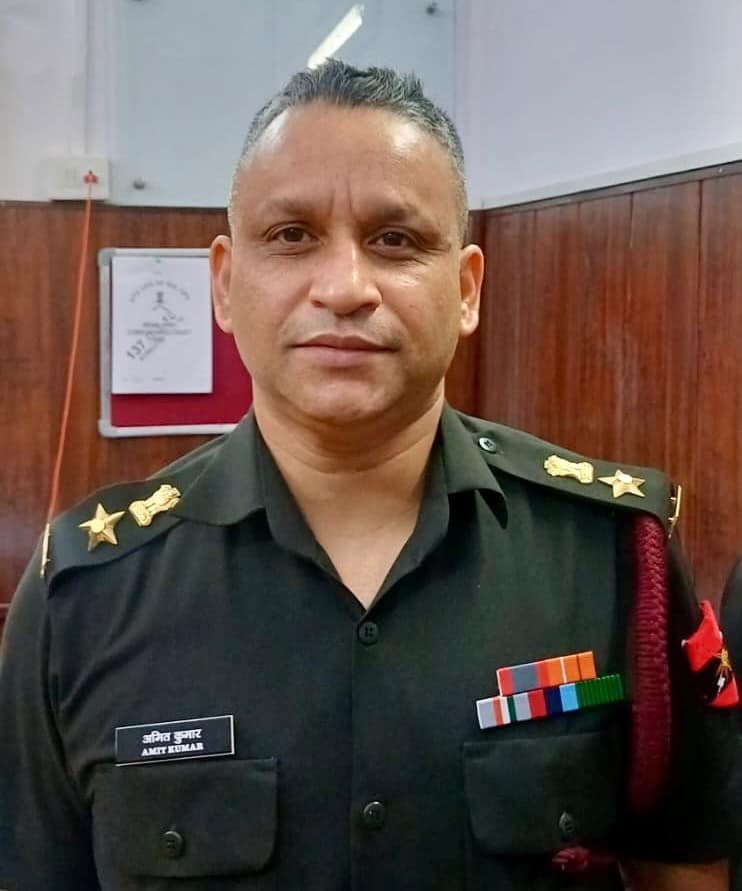
Prahaar Major Chauhan Leadership Lessons: Every society is shaped not only by its institutions but also by the character of those who uphold them. Discipline, moral courage and leadership are rarely inherited; they are cultivated through example. Few fictional characters have embodied these values as convincingly as Major Chauhan from Prahaar. I first met Major Chauhan on a cinema screen, not a parade ground. More than three decades and over two decades in uniform later, my mind invariably returns to him whenever I think about discipline and leadership. Some films entertain. A few inspire. Very few shape the way an entire generation thinks. Prahaar belongs to that rare category.
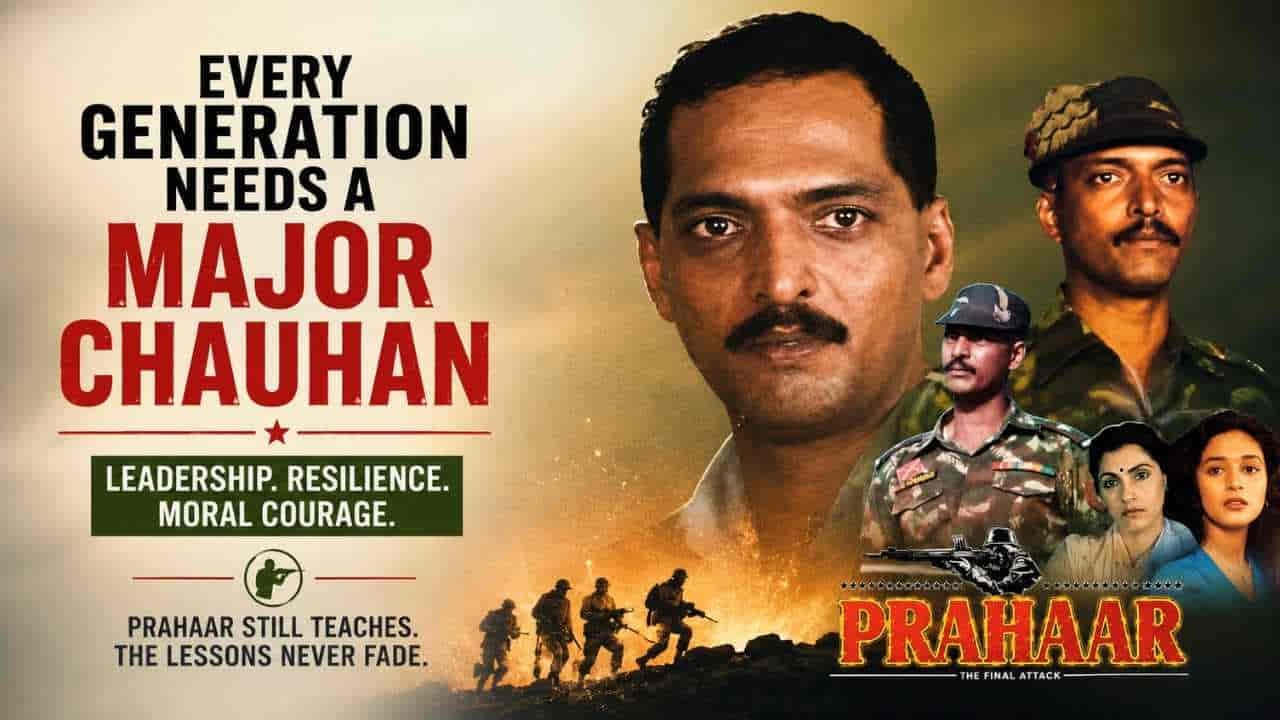
It was never merely a military film. Beneath the fatigues, obstacle courses and rigours of commando training lay a deeper meditation on discipline, resilience, leadership and moral courage. Those qualities have not become outdated with the film. If anything, they appear increasingly relevant in an age that often seeks quick results without embracing the hardship required to achieve them. Major Chauhan, portrayed with remarkable conviction by Nana Patekar, looked every inch the soldier. His close-cropped haircut, chiselled physique, immaculate bearing and quiet authority remain etched in my memory. Yet what made the character memorable was his character. For him, discipline was not something imposed by rank. It was a way of life.
Prahaar Major Chauhan Leadership Lessons: Leadership Begins by Doing
One of the most enduring lessons from Prahaar is Major Chauhan’s understanding of leadership. He does not merely order his trainees to endure hardship; he demonstrates what he expects from them. The obstacle-course sequences capture this beautifully. Faced with demanding physical tasks, fatigue and fear, trainees naturally hesitate. Major Chauhan does not stand at a safe distance delivering motivational speeches. He leads from the front. Military leadership is particularly unforgiving in this respect. Rank may give a person authority, but authority alone cannot command respect. Soldiers observe far more than they are told. They notice whether a leader shares hardship, whether his standards apply equally to himself, and whether he remains composed when circumstances become uncomfortable. During my years in uniform, I have increasingly understood this distinction. Leadership is not demonstrated through words alone; it becomes visible under adverse circumstances. It is easy to demand resilience. It is considerably harder to demonstrate it. Major Chauhan does precisely that.
Peter D’Souza: Transformation Through Belief
Then there is Peter D’Souza. His journey is important because it shows that military training is not simply about producing physical toughness. It is about discovering capacities that an individual himself may not know he possesses.
Peter begins as a trainee struggling against demanding standards. Major Chauhan pushes him relentlessly, but the purpose is not humiliation. It is transformation. He sees potential before Peter fully recognises it in himself. When Peter eventually earns the Commando Dagger, the moment represents much more than successful completion of training. It symbolises confidence earned through adversity. It reflects leadership through belief, not humiliation—the conviction that ordinary people are capable of extraordinary courage when someone refuses to lower standards. That distinction matters far beyond military training. Leaders from all walks of life encounter the same choice. Do we lower every obstacle when someone struggles, or do we sometimes help that person develop the strength required to cross it? True mentoring lies somewhere between cruelty and indulgence. It demands without destroying. It corrects without humiliating. It recognises that confidence acquired without struggle can be fragile, while confidence earned after confronting one’s limitations is far more durable. Peter’s transformation captures that principle.
A Soldier Never Quits
Major Chauhan’s philosophy can perhaps be reduced to one simple creed: a soldier never quits. But the statement means more than physical endurance. Not when the body is exhausted. Not when fear takes hold. Not even when one finds oneself standing alone against overwhelming odds. That is why the film’s final confrontation is so significant. Major Chauhan faces an adversary that is not merely an individual but symbolic of something much larger—an entrenched culture of intimidation and wrongdoing. He knows that eliminating one manifestation of it cannot eliminate the entire problem. Yet he refuses to use the enormity of the problem as an excuse for inaction.
His message is essentially this: you may continue doing what you do, but I will continue doing what I must. That, to me, is resilience in its most uncompromising form. Resilience is sometimes misunderstood as an expectation that victory will eventually be guaranteed. It is not. There are situations in military service and in ordinary life where the outcome cannot be assured. One may do everything correctly and still encounter failure. The real test then becomes whether uncertainty about the outcome becomes an excuse to abandon the effort. A soldier’s training teaches precisely the opposite. Continue the task. Adapt. Recover. Move again. That philosophy is useful far beyond battle.
Physical Courage and Moral Courage
Prahaar also forces us to consider another distinction: the difference between physical courage and moral courage. Physical courage is visible. It may involve confronting danger, enduring pain or entering situations from which instinct tells us to withdraw. Moral courage can be quieter and, at times, lonelier. It is the courage to speak when silence would be convenient. To stand by a principle when compromise would be easier. To continue doing what is right when applause is absent and perhaps even when opposition is certain.
Military training develops physical endurance because a soldier may one day need it. But its deeper purpose is to develop a mind capable of functioning when comfort disappears. That is why discipline matters. Discipline is often mistaken for obedience. The two are not identical. Obedience may depend upon the presence of authority. Discipline remains when nobody is watching. A person who behaves correctly only because someone is supervising him has complied with a rule. A person who maintains standards when there is no supervision has developed character.
That difference lies at the heart of Major Chauhan.
What Can the Citizen Learn From the Soldier?
Perhaps the most enduring idea associated with Major Chauhan is that every citizen should experience military discipline for a period of time. Taken literally, that proposition can invite debate. But its deeper meaning deserves attention. The purpose is not to turn every citizen into a soldier. It is to make citizens more conscious of the freedom soldiers guard. Military life teaches certain habits with relevance far beyond the battlefield: consistency, punctuality, accountability, teamwork, physical resilience, respect for responsibility and the understanding that individual convenience cannot always take precedence over a collective task. None of these values belongs exclusively to the armed forces. A society needs them too. Imagine public life in which punctuality is regarded as respect for another person’s time, public property is treated as a collective responsibility, physical fitness is understood as personal responsibility, and duty is performed properly even when supervision is absent.
One does not need to wear a uniform to practise these values. That is why Major Chauhan’s message survives beyond the Commando Wing.
What the Uniform Eventually Teaches
More than two decades in uniform have taught me that military training is not about creating people who enjoy hardship. It is about creating people who continue to persevere despite it. The uniform does not eliminate fear, exhaustion, disappointment or doubt. Soldiers remain human. What training attempts to change is the response to those emotions.
You learn to perform a task despite fatigue. You learn that another person’s safety may depend upon your reliability. You learn that excuses may explain failure but cannot always undo its consequences. Above all, you learn that discipline practised repeatedly eventually becomes less of an instruction and more of an instinct.
This is why the lessons of military life often remain long after a particular appointment, course or posting has ended. And this is also why a fictional officer from a film released decades ago can continue to resonate with someone who subsequently spent years wearing the uniform himself.
As a young viewer, I saw toughness. As a soldier, I began to see leadership. With passing years, I increasingly see something else: character.
Beyond the Uniform
The enduring relevance of Prahaar lies precisely here. Major Chauhan should not be remembered merely because he represents an exceptionally tough commando instructor. His larger significance lies in the proposition that character is created through repeated choices—getting up when remaining down would be easier, accepting responsibility when excuses are available, and doing one’s duty even when nobody is likely to reward it.
Nations certainly need strong armed forces. But national strength cannot be produced by armed forces alone. A soldier can defend a border. He cannot single-handedly create honesty in public life, responsibility in institutions, discipline on roads, compassion within communities or courage in ordinary citizens. Those responsibilities belong to society.
As we speak of national strength, perhaps we should therefore ask not only how strong our military is, but how strong our collective character remains. A nation is protected not only by its soldiers at the border but also by the values and character of its citizens. Armies defend our frontiers. Character defends the values that make those frontiers worth protecting.
More than three decades after Prahaar, Major Chauhan therefore remains relevant—not because every citizen must become a commando, but because every generation confronts its own forms of fear, complacency, adversity and moral compromise. Every generation needs examples reminding it that discipline matters, that leadership begins with example, that courage extends beyond the battlefield and that difficult odds do not absolve us of responsibility.
Every generation needs a Major Chauhan. More importantly, every generation needs the courage to become one.