
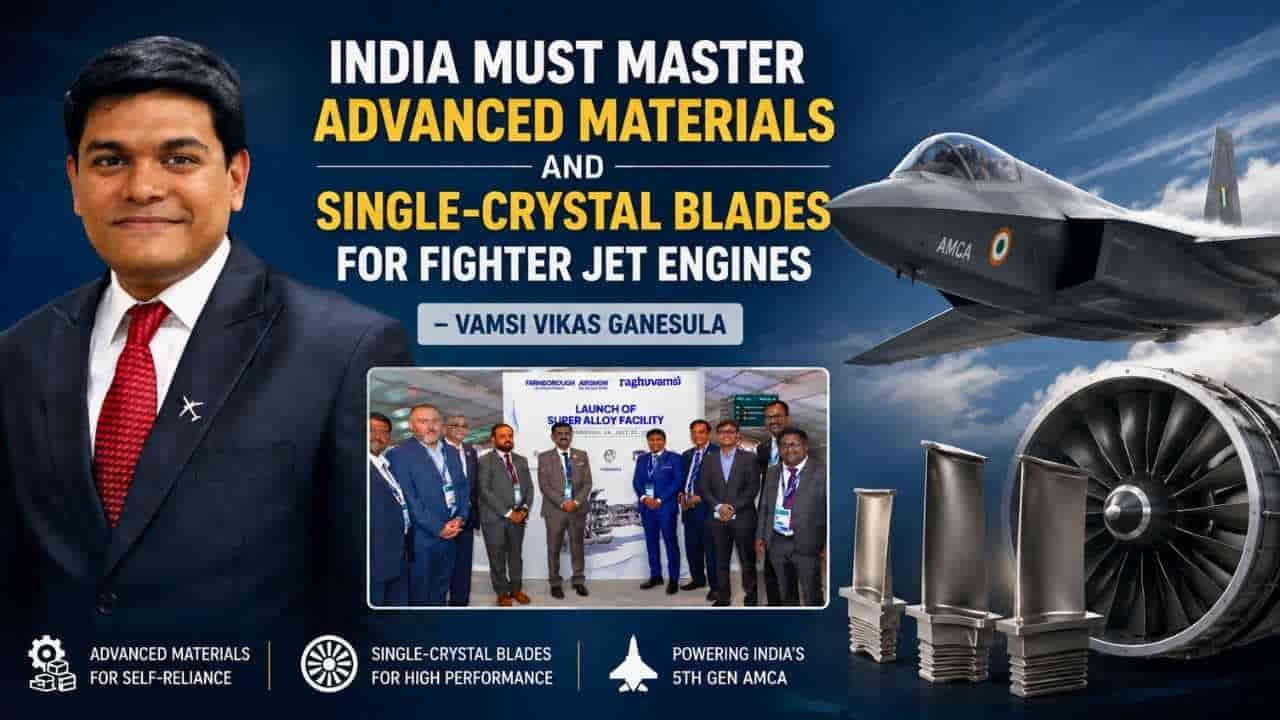
📍New Delhi | 2 Aug, 2026, 2:20 PM
Hyderabad-based Raghu Vamsi Aerospace Group has announced an investment of over Rs. 600 crore to set up a 50-acre integrated nickel-based superalloy manufacturing facility in Telangana. Announced at the Farnborough International Airshow 2026, the project aims to strengthen India’s domestic supply chain for critical aerospace and defence materials.
Against this backdrop, Raksha Samachar spoke with Vamsi Vikas Ganesula, Managing Director of Raghu Vamsi Aerospace Group, about defence indigenisation, indigenous propulsion and UAV technologies, the AMCA programme, fighter jet engines, and India’s emergence as a global aerospace manufacturing hub.
Q: India is witnessing a major push towards defence indigenisation. How is your group contributing to the Atmanirbhar Bharat mission in aerospace and defence?
A: The effort towards indigenisation in defence is very similar to our Group’s long-term goals and vision. We are supporting the mission by developing indigenous capabilities related to precision manufacturing, propulsion, and autonomy. Specifically, we aim to develop micro turbine jet engines and unmanned systems from within India. Alongside that, we are making investments in aerospace manufacturing capacity. We are developing long-term programmes in relation to defence and aerospace by making use of our manufacturing abilities. These programmes include much more than just assembly-level indigenisation but, more significantly, focus on creating strategic industries and capabilities.
Q: Your group has expanded from precision manufacturing to developing indigenous microturbojet engines and UAV technologies. What has driven this strategic shift?
A: Moving from precision machining towards building indigenous microtubrojet engines and Unmanned Aerial Vehicles (UAVs) has been a logical progression of moving from component manufacture to system development. A key driver has been the desire to move higher in the aerospace value chain, along with the growing need for indigenous propulsion and autonomous technologies. We have also been able to leverage decades of aerospace manufacturing expertise and ecosystem relationships in this journey.
At the same time, the focus has been on building long-term intellectual property and technology ownership.
Q: What are the biggest gaps that still need to be addressed for India to emerge as a global aerospace manufacturing hub?
A: In order for India to become a manufacturing destination for aerospace components globally, the need arises for even greater development of the supplier base at the Tier-2 and Tier-3 levels. Greater availability of aerospace materials and process capabilities would also make a difference.
In addition, the establishment of highly sophisticated test and qualification facilities would become essential, along with enhanced scalability and consistency in the supply chain. Increased investment in propulsion technology would be crucial.
🚀🇮🇳 Major leap for India’s aerospace and defence ecosystem!
At the Farnborough International Airshow 2026, Raghu Vamsi Aerospace Group announced a ₹600+ crore investment to establish a 50-acre integrated nickel superalloy manufacturing facility in Telangana. The plant, with an… pic.twitter.com/etma3NOqJu— Raksha Samachar | रक्षा समाचार 🇮🇳 (@RakshaSamachar) July 22, 2026
Q: How do you assess the impact of recent defence reforms on the growth of private-sector participation in aerospace and defence manufacturing?
A: Recent defence reform has created greater assurance for the private sector’s involvement in defence manufacturing, as well as greater scope for private industry involvement in strategic programmes. It has also expedited indigenous research and development, while promoting cooperation between the government and the private industry. In general, it has helped create a balanced ecosystem of the defence industry.
Q: With increasing geopolitical uncertainties and supply-chain realignments, what opportunities do you see for Indian aerospace companies in global markets?
A: Given that geopolitical and supply chain risks are growing, there is also a need for greater resilience and diversification for many OEMs, thus presenting new avenues for Indian manufacturing.
Further, export opportunities are rising in the aerospace & defence sectors, and reliable sources are needed for companies capable of manufacturing the required items. This offers Indian companies opportunities to rise above supplier roles and engage in programs as partners.
Q: Among emerging programmes such as drones, missiles, helicopters, and fighter aircraft, which sectors do you believe will drive the next phase of growth for Indian defence manufacturing?
A: Unmanned and autonomous systems, as well as aero engine and propulsion technologies, are going to drive the next wave of growth in the Indian defence manufacturing sector. This growth can also come from missiles and guided weapons and their subsystems, as well as from fighter aircraft and helicopters. Along with these, it is also expected that counter-UAS technologies and mission system technologies are going to have an important part to play in growth.

Q: The AMCA programme marks a significant opening for private industry. What does this shift signal for the future of India’s defence-industrial ecosystem?
A: In terms of the AMCA programme, it not only marks the advancement of private-sector capabilities and maturity but also provides greater room for industry involvement in strategic national programmes. The programme supports long-term investments in technology and infrastructure and the growth of local aerospace and defence supply chains. Overall, the programme indicates the transition towards a more cooperative and competitive defence sector ecosystem.
Q: Developing an indigenous high-thrust fighter engine remains one of India’s biggest technological challenges. What are the key bottlenecks that must be overcome?
A: The development of a high-thrust fighter jet engine involves several major challenges. These include advanced materials and high-temperature metallurgy, as well as single-crystal blade technologies and coatings. Additionally, long-term testing and validation capabilities, as well as decades-long investments and continuity, are required. Finally, the close integration of research, manufacturing, and testing infrastructure plays an equally important role.
Q: What lessons from your Group’s work on indigenous microturbojet engines can be applied to India’s ambitions for advanced fighter-engine development?
A: The development of microturbojet engines confirmed once again that propulsion development is not just a matter of engineering and technical skills but also requires persistence and patience. In addition, the process made us realize that testing and validation play an equally significant role as development itself. The process proved that materials and manufacturing processes are crucial aspects of the work. Finally, our main lesson from the experience was that ecosystems play a greater role than technology breakthroughs.
Q: How can government, industry, and research institutions collaborate more effectively to accelerate self-reliance in critical aerospace technologies?
A: A synergy between the government, industry, and research organizations could be better achieved through the creation of common aerospace technology roadmaps that span years. Another aspect where synergies can be realized is through strengthening industrial collaborations with academia and research organizations. This would require setting up testing and qualification facilities as well as faster technology transfer from the lab to production. Alongside, investments for deep-tech development must continue to grow.
Q: By 2035, where do you see India’s aerospace and defence sector in the global landscape, and what role do you expect your group to play in that journey?
A: By 2035, we envisage India becoming a preferred partner in aerospace manufacturing in the world with significant participation in international civil and defence programmes. In this endeavor, we also anticipate the emergence of a fully-fledged indigenous aerospace propulsion and technology eco-system, along with increased contributions toward the export of aerospace and defence products. This includes our vision at RVAG, which would be making contributions to the development of manufacturing technologies and autonomous technologies.