📍New Delhi | 13 Jan, 2026, 7:28 PM
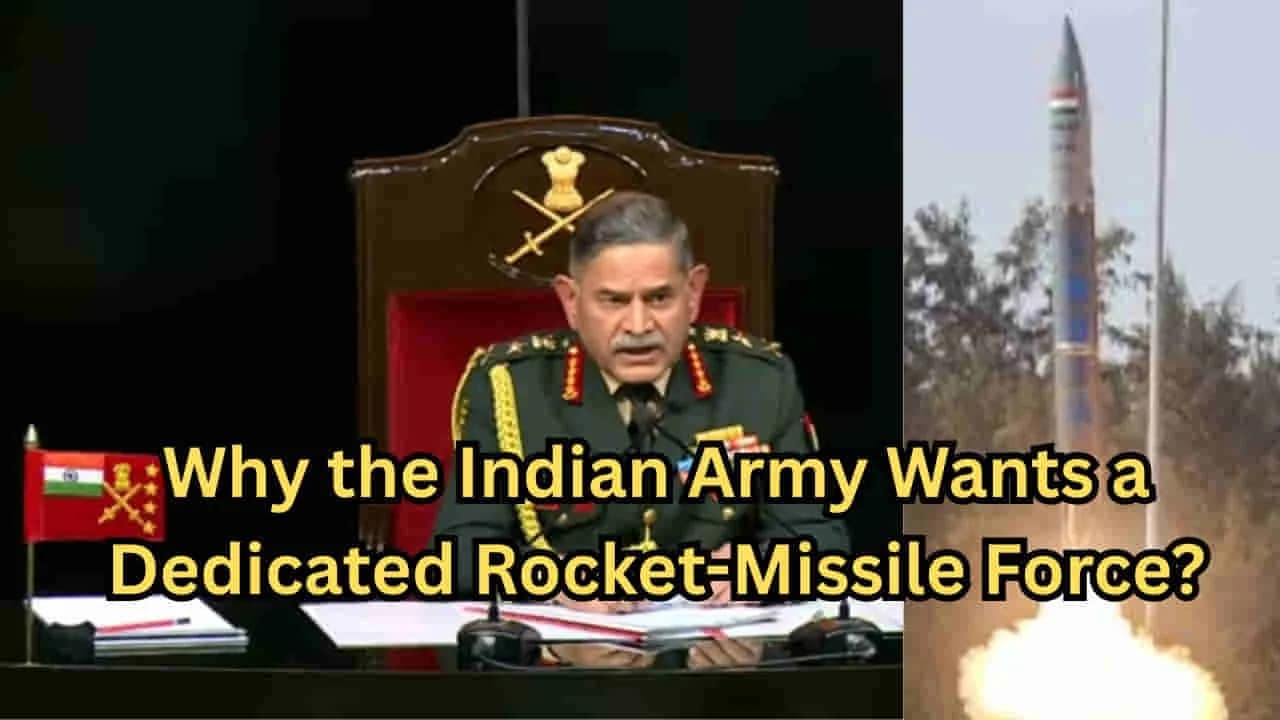
Rocket-Missile Force: The Indian Army is moving decisively towards creating a dedicated rocket-missile force to significantly enhance its long-range strike capability, Chief of Army Staff General Upendra Dwivedi said on Tuesday, underlining that future conflicts will demand faster, deeper and far more precise firepower.
Addressing the media, the Army Chief said the nature of modern warfare is rapidly evolving, requiring forces to possess the ability to strike targets at long distances with speed and accuracy.
Rocket-Missile Force: Rockets and Missiles- A Blurring Divide
General Dwivedi said the traditional distinction between rockets and missiles is steadily disappearing, with both systems now capable of delivering decisive battlefield impact.
“We need a missile force. Today, rockets and missiles have become intertwined. If we want to achieve an impact, both rockets and missiles can deliver it,” he said, stressing that India cannot afford to lag behind regional adversaries in this critical military domain.
According to him, the integration of rockets and missiles into a unified force structure will allow the Army to respond swiftly across multiple scenarios, from conventional conflicts to limited high-intensity engagements. (Rocket-Missile Force)
Pakistan and China as Key Drivers
The Army Chief pointed out that both Pakistan and China have already raised specialised rocket forces, making it imperative for India to develop similar capabilities.
“Pakistan has established a rocket force, and China has also created such a force. It is the need of the hour that we also establish such a force,” he said, indicating a clear doctrinal shift in the Army’s approach to long-range fires and deterrence. (Rocket-Missile Force)
Pinaka at the Core of Transformation
At the heart of this transformation is the indigenous Pinaka multi-barrel rocket launcher system. General Dwivedi revealed that the latest version of Pinaka has already been successfully tested to a range of 120 kilometres.
“We have tested the Pinaka system with a range of 120 km. We have also signed several other contracts that will explore ranges up to 150 km,” he said.
He added that the Army has laid out a clear roadmap for future upgrades, with extended-range variants expected to dramatically boost India’s strike depth. (Rocket-Missile Force)
Ambitious Roadmap: 300-450 km Range
According to the Army Chief, the Pinaka programme will not stop at 150 km. Future versions are expected to reach ranges between 300 and 450 kilometres, substantially enhancing the Army’s ability to strike deep into hostile territory while maintaining conventional deterrence.
Such capabilities, military planners believe, will provide commanders with more options during crises, allowing calibrated responses without immediate escalation. (Rocket-Missile Force)
Pralay and BrahMos in the Arsenal
Beyond rockets, General Dwivedi also highlighted India’s expanding missile inventory, referring to systems that bridge the gap between conventional artillery and strategic missiles.
“You must have also heard about Pralay and BrahMos too,” he said, pointing to their growing role in operational planning.
The Pralay missile, developed indigenously, offers a short-range, high-precision strike option designed to neutralise high-value enemy targets. Meanwhile, the BrahMos, jointly developed with Russia, remains one of the fastest supersonic cruise missiles in the world and is already deployed across the Army, Navy and Air Force. (Rocket-Missile Force)
Strengthening Deterrence and Future Warfare
Military planners see the proposed rocket-missile force as a crucial pillar of India’s deterrence posture, particularly along its northern and western borders. By combining long-range rockets like Pinaka with precision missiles such as Pralay and BrahMos, the Army aims to create a layered strike capability capable of delivering rapid and decisive blows without crossing nuclear thresholds.
General Dwivedi’s remarks signal that the Indian Army is not only modernising its weaponry but also rethinking its force structure to meet the demands of future warfare, where speed, range and precision will define battlefield dominance. (Rocket-Missile Force)