📍New Delhi | 29 Dec, 2025, 5:57 PM
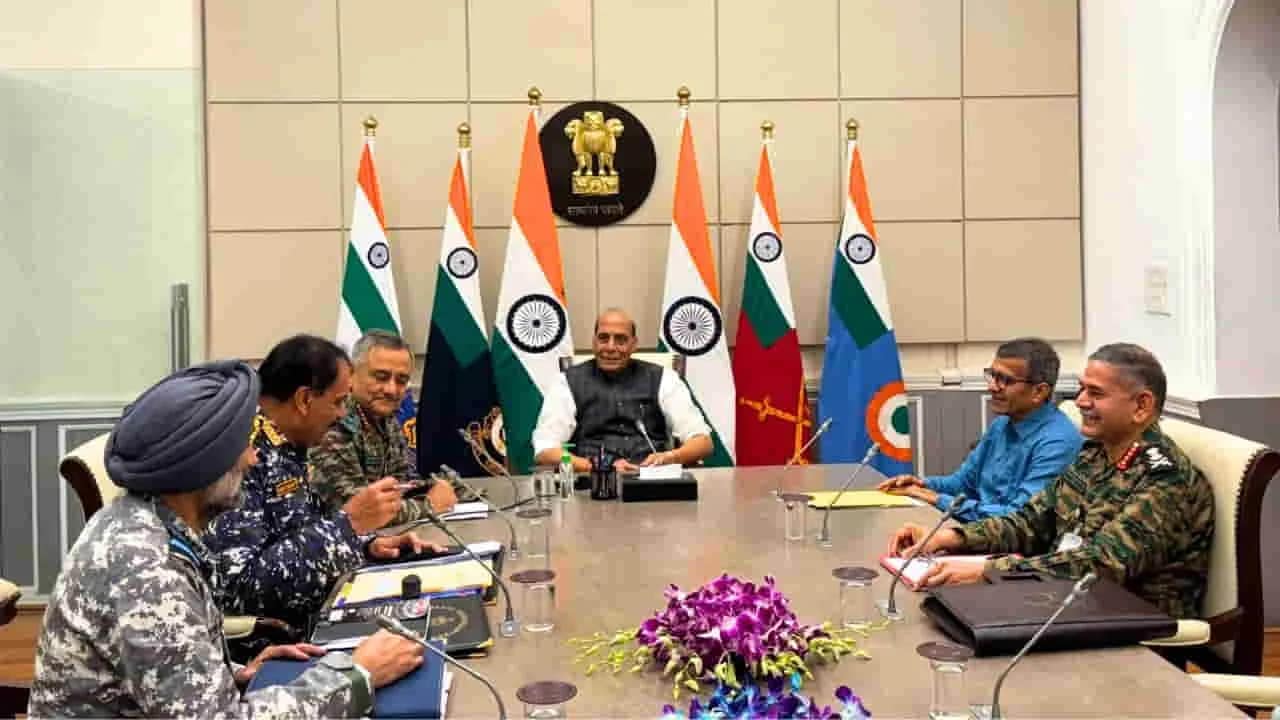
DAC Meeting 2025: In one of the largest defence procurement clearances of the year, the Defence Acquisition Council (DAC), chaired by Defence Minister Rajnath Singh, on December 29 accorded Acceptance of Necessity (AoN) for proposals worth nearly Rs 79,000 crore, significantly bolstering the operational capabilities of the Indian Army, Navy and Air Force.
The approvals underline India’s accelerating pivot towards counter-drone systems, long-range precision strikes and enhanced surveillance amid evolving battlefield threats.
The decisions were taken at a DAC meeting held in New Delhi, marking a decisive push towards future-ready, technology-intensive warfare, with a strong emphasis on indigenisation and force modernisation.
Army Focus: Counter-Drone Shield and Long-Range Firepower
For the Indian Army, the DAC cleared a series of high-impact proposals reflecting lessons from recent global conflicts, particularly the growing dominance of drones and precision-guided munitions.
A key clearance is for the Integrated Drone Detection & Interdiction System (IDD&IS) Mk-II, a next-generation counter-drone solution equipped with a high-power laser weapon. Designed to detect, track and neutralise hostile drones at extended ranges, the system integrates passive detection, wideband monitoring and precise electronic countermeasures.
🇮🇳🛡️ Major Boost to India’s Military Modernisation in DAC Meeting
The Defence Acquisition Council has approved defence procurement proposals worth ₹80,000 crore, strengthening capabilities across the Army, Navy and Air Force.
Key approvals include:
🔹 Overhaul of T-90 tanks
🔹…— Raksha Samachar | रक्षा समाचार 🇮🇳 (@RakshaSamachar) December 29, 2025
Crucially, it can identify low-power, frequency-agile and non-standard drone signals, making it effective against swarm tactics and electronic warfare-enabled threats. The system will protect vital military assets in tactical battle areas as well as population centres in the hinterland.
Complementing this is the approval for Low Level Light Weight Radar (Improved) – LLLR(I), a specialised surveillance radar tailored to detect small, low-flying unmanned aerial systems that often evade conventional radars. Its induction is expected to significantly enhance situational awareness along sensitive borders and critical installations.
Precision Strike and Deep Reach Capabilities
The DAC also cleared procurement of Loiter Munition Systems, described by the Army as a major force multiplier. These “kamikaze drones” combine surveillance and strike capabilities, enabling precision engagement of high-value targets with minimal collateral damage. Indigenous loiter munitions will equip newly raised Shaktibaan and Divyastra units, allowing precision strikes deep into enemy territory even in electronically contested environments. Beyond physical damage, their psychological impact is seen as a key advantage.
Further enhancing deep-strike capacity, the DAC approved Long Range Guided Rocket Ammunition for the Pinaka Multiple Launch Rocket System (MLRS). While existing Pinaka rockets have a range of up to 75 km, the new guided rockets can strike targets up to 120 km away with high accuracy. Developed indigenously, the podded ammunition comes with four different warhead options, enabling tailored responses against high-value enemy targets.
Navy and Air Force: ISR, Mobility and Training Boost
For the Indian Navy, AoN was granted for procurement of Bollard Pull Tugs, essential for maneuvering ships and submarines in harbours, along with High Frequency Software Defined Radios (HF SDR) Manpack to ensure secure long-range communications during boarding and landing operations. The clearance to lease High Altitude Long Endurance (HALE) Remotely Piloted Aircraft Systems is particularly significant, as it will dramatically improve maritime Intelligence, Surveillance and Reconnaissance (ISR) and strengthen Maritime Domain Awareness across the Indian Ocean Region.
The Indian Air Force received approvals for Astra Mk-II beyond-visual-range air-to-air missiles, SPICE-1000 precision guidance kits, Full Mission Simulators for LCA Tejas, and an Automatic Take-off and Landing Recording System. Together, these acquisitions enhance standoff strike capability, air combat dominance, pilot training efficiency and aviation safety.
Strategic Signal
Taken together, the Rs 79,000-crore clearances reflect a strategic recalibration of India’s military posture-one that prioritises technological superiority, indigenous development and preparedness for multi-domain conflicts. With drones, precision strikes and electronic warfare redefining modern battlefields, the DAC’s decisions underscore India’s intent to stay ahead of emerging threats while strengthening self-reliance in defence manufacturing.