
📍New Delhi | 12 Aug, 2026, 12:52 PM
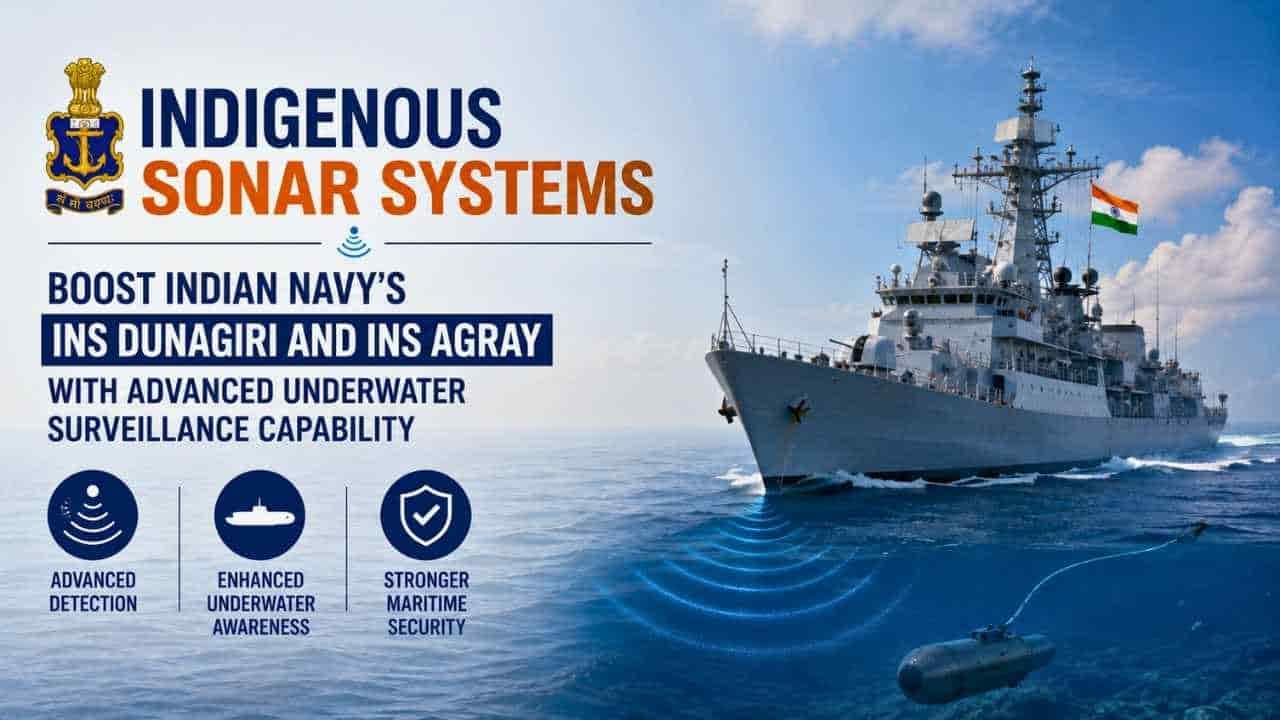
NPOL Indigenous Sonar System: The Indian Navy is not only a roll of missiles, warships and submarines in increasing strength, but has also grown from techniques that can identify hidden threats within the sea. Indigenous sonar systems have been deployed in two indigenous warships of the Indian Navy recently commissioned INS Dunagiri and INS Agray. On June 21, Prime Minister Narendra Modi had joined the Navy to both the indigenous warships in Kolkata. Over 75 percent of indigenous materials have been used in these ships.
Sources pointed out that these sonar systems are located Kochi DRDO The laboratory of Naval Physical and Oceanographic Laboratory (NPOL) has developed.
Let's say that Stellth Frigate INS Dunagiri and Anti-Submarine Warfare Shalo Water Craft INS Agray has been built by Garden Reach Shipbuilders and Engineers (GRSE).
NPOL Indigenous Sonar System: How does the sea work within the sonar?
The sonar is equally important for any warship within the sea, as much as radar for flying aircraft in the sky. This system works to detect hidden submarines, torpedo and other hazards within the water.
Sonar is considered to be the eye and ears that are seen and heard within the water of any warship. The submarines inside the sea, torpedo and other underwater platforms do not appear from the normal radar. Sonar identifies them through sound waves.
The sonar works in two ways. In the active mode it sends the sound wave and detects the location of the target from the return echo. In the Passive mode it only listens to the surrounding sounds and identifies the target based on them. The role of sonar in the modern naval war is considered to be extremely important as the dangers from the submarines are constantly increasing.
Why is NPOL special?
Kochi-based Naval Physical and Oceanographic Laboratory (NPOL) is considered as the backbone of India’s underwater surveillance and anti-submarine warfare techniques. This lab has been devoting sonar and underwater sensors for Indian Navy for years.
Sea temperature in the Indian Ocean region, water depth, sea streams and vessels movement is constantly changing. It is not easy to detect submarines in such an environment. The systems of NPOL are designed to take into account these challenges. (NPOL Indigenous Sonar System)
INS Dunagiri Felt on HUMSA-2020
Project-17A Under Ready INS Dunagiri A modern stalth guided missile is Frigate. This warship needs to identify the enemy’s submarines and other underwater threats at a long distance.
The warship has been equipped with HUMSA-2020 i.e. HUMSA-NG Mark-II Sonar, according to sources.
It is the fourth generation hull-mounted active-low-passive sonar. It has been designed by NPOL, while it has been built by Bengaluru-based India Electronics Limited.
This system works in both active and passive modes. The active detection range of HUMSA-2020 is about 40 kilometres. It can track eight different targets simultaneously. It has facilities like Automated Torpedo Detection, Digital Data Recording, Target Library and Advanced Signal Processing.
High-resolution multi-function consoles have been installed in order to inform the operators of the warship. These consoles show together the data from sonar and other sensors, allowing operators to decide faster. (NPOL Indigenous Sonar System)
monitors the activity of the enemy submarine
HUMSA-2020 includes several advanced features. It has capabilities such as Adaptive Processing, Broadband and Narrowband Analysis, Digital Data Recording and Automated Torpedo Detection.
The system also prepares the target library for acoustic identification of the target. A submarine or underwater platform can be identified more accurately.
If an enemy submarine is detected already, the warship can use torpedo, anti-submarine rocket or other weapons safely.
It also has facilities like Sonar Performance Modeling System and Near-field Acoustic Characterization System. High-resolution multi-function consoles are available for operators, where information from radar and sonar can be viewed together. (NPOL Indigenous Sonar System)
This system is already deployed on many warships
Sources pointed out that DRDO had developed HUMSA-2020 by upgrading HUMSA-NG with new electronic architecture from 2019 to 2022. The system has already been deployed on several warships of the Indian Navy.
More than 16 orders have been given for this. These include seven warships of Project-17A, Warship of the Sword Category, Additional Sword Class Ship, INS Rana and INS Brahmaputra. (NPOL Indigenous Sonar System)
INS Abhay PG specially designed for Agray
Where INS Dunagiri works in the open sea, INS Agraha The main task of is to explore submarines in coastal and shallow marine areas. The sonar operation in such areas is much challenging as marine waves, rocks, sea level textures and traffic of ships affect sound signals.
That’s why NPOL has paved the special Shalo water sonar named Abhay PG for INS Agray. It also works in both active and passive modes.
This is a compact hull-mounted active-low-passive sonar designed specifically for small warships and anti-submarine warfare platforms. (NPOL Indigenous Sonar System)
able to identify submarines in shallow seas
PG Shello Water sonar suit part of. It can detect, localize, classify, and track both of the targets present within the surface and water.
This system includes transducer array, data emission system, power amplifier and dual multi-function console. It has been used advanced signal processing technology, allowing real targets to be identified by separating unwanted noises present in the sea.
This system is considered to be the indigenous option of the system of foreign and Russian origin, previously used. (NPOL Indigenous Sonar System)
16 Anti-submarine warships will take it sonar
The sources pointed out that Abhay PG plans to plant 16 Shalo Water Crafts of the Indian Navy. These include the Arnala Class Anti-Submarine Warfare Ship being made by GRSE and Cochin Shipyard Limited.
The main task of these warships is to protect the coastal areas of India and important marine routes. Sonars that work effectively in the shallow sea are considered essential. (NPOL Indigenous Sonar System)
Special design for Indian Ocean conditions
The sources pointed out that both sonar systems have been developed by taking into account the special conditions of the Indian Ocean region. Sound behavior in tropical marine areas is different from cold seas. The foreign system does not always give the best results.
NPOL has prepared these systems in line with Indian marine conditions. This gives Indian Navy better underwater monitoring capacity in local environments. (NPOL Indigenous Sonar System)