
📍New Delhi | 2 Jul, 2026, 8:43 PM
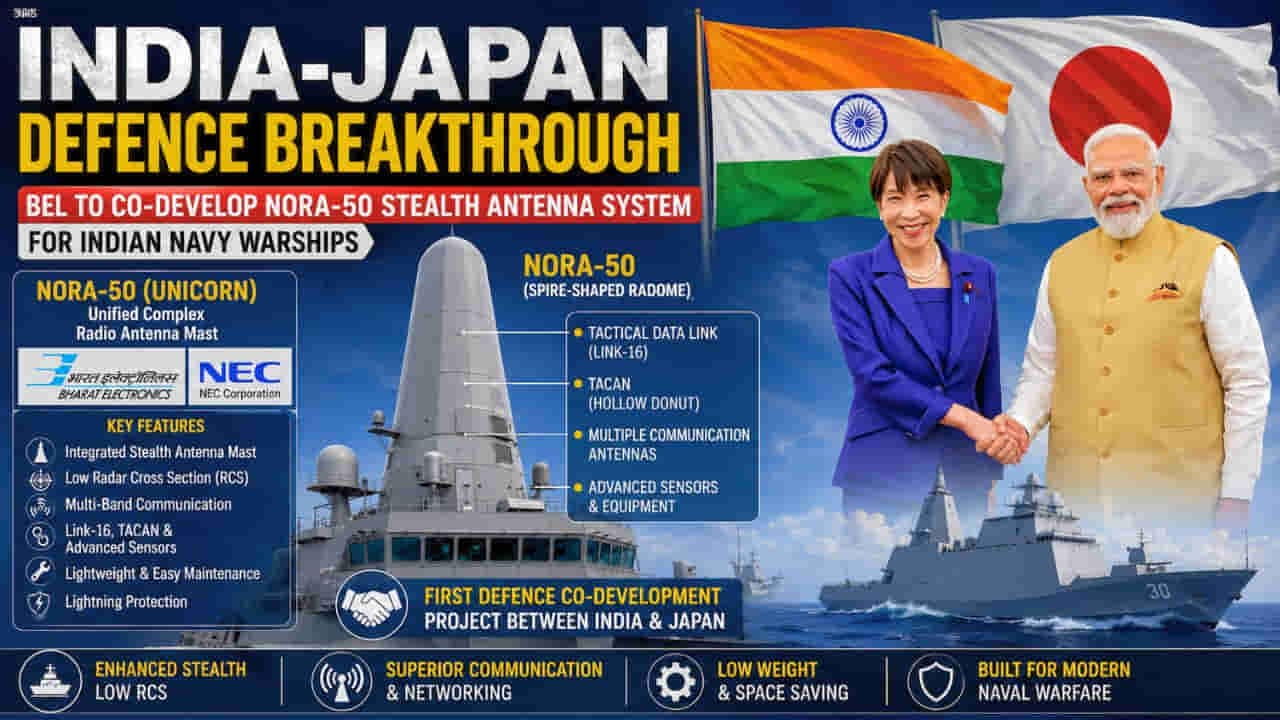
NORA-50 Stealth Antenna System: India and Japan have stepped down towards co-development and co-production for the first time in the field of defence technology. During the India-Japan Summit on Thursday, Unicorn (UNIted COnbined Radio aNtenna) project was agreed to pursue as the first defense co-development program of both countries. Under this project, Japan’s state-of-the-art NORA-50 stalth antenna mast technology will be paved and manufactured in India. While India Electronics Limited (BEL) will play a major role in the project on behalf of India.
NORA-50 Stealth Antenna System: What is NORA-50 and why is it special?
NORA-50 really according to formulas Unicorn (UNIted is the Japanese name of COnbined Radio aNtenna) system. This is an integrated stalth antenna mast, which Japan has paved for the modern warships of its Navy.
Different antennas are mounted for communications, radars, data links and various sensors in traditional warships. This makes the upper part of the ship quite complex and its radar cross section (RCS) increases. The higher the radar cross section, the easier it will be to detect the ship for the enemy radar.
NORA-50 replaces this whole system. All major antennas and sensors are integrated within the same mast. The outer part of the ship remains neat and its stalth capacity increases significantly.
First Project between India and Japan
The project was signed in Tokyo in November 2024. Now India-Japan Summit It has been formally pursued as the first joint defence development programme of both countries.
India Electronics Limited (BEL) on behalf of the Indian side will play a major role in the project. The Company will develop and produce this system in India. The Japanese side will provide its technical expertise and design. According to the formulas, it will also develop high-level naval electronics manufacturing capability in India.
Japan’s three big companies have devlop technology
NORA-50 The system has been developed by Japan’s NEC Corporation. Sampa Cogyo K.K. and The Yokohama Rubber Co. Ltd. has also been technical cooperation in the project.
This system is currently being used on Japan’s state-of-the-art Mogri Class (30FFM) Stellth Frigate. Now this technique is being shared with India.
Why is it important for Indian Navy?
Sources say modern Naval Warfare The only weapons are not decisive, but also the ability to hide the identity of the ship, maintain safe communication and quickly share information that meets various sensors is equally important.
NORA-50 meets all these needs together. That’s why it’s counted in the most important techniques of modern stalth warships.
Fiber Reinforced Plastic Made Of Full Mast
The outer part of NORA-50 is prepared from fiber reinforced plastic (FRP) redome according to formulas. It is able to withstand light as well as sea seasons.
It remains durable even longer in marine air, moisture and fast temperature. Also its maintenance is easier than traditional metal structures.
Spur Shape grows from design Stellth Capacity
The design of NORA-50 is not as common antenna mast. Its size is placed as a spay shape or bar shape dome. The purpose of this special design is to reduce the refluence of radar waves. When the radar cross section of a warship is lower, it becomes more difficult to identify her right for the enemy.
NORA-50 is not only the communication antenna according to the formulas, but it is an integrated electronic system.
It consists of Tactical Data Link, Link-16, Tactical Air Navigation System (TACAN), various communication antennas and many other sensors mounted together.
The same systems during the war work to share safe data between ships, helicopters, sea patrol aircraft and other naval platforms.
What is Link-16?
Link-16 is a safe military data network used by Western countries and NATO forces, according to sources. Through this, various platforms during the war can share information of targets in real-time, enemy status and data associated with operation. This is why it is considered to be the important part of the modern network-based war system.
Changes to TACAN System
The formulas say the Tactical Air Navigation System (TACAN) in NORA-50 is also included with new design. The TACAN antenna in traditional vessels was mounted on the uppermost part of the mast. But in NORA-50 it is installed downwards.
Also the place of the traditional disk Hallo Donut size has been adopted. This reduces the possibility of identification from the radar while there is no effect on the functionality of the system.
How does the electronic system of the whole warship change?
The problem of electromagnetic interference between them was also due to different antennas on a warship before formulas. All antennas in NORA-50 are mounted in a scientific manner. This improves the quality of the signal and various systems do not affect each other.
While NORA-50 has many advantages. Shipment Radar Cross Section Reduces, thereby increasing the stalth capacity. Communication and radio reception are strong due to the better condition of the antenna. Many different antenna removal reduces ship weight and saves place. Maintenance becomes easier and protection is also better for natural reasons like power falls. Also this system is able to communicate on multiple frequency bands simultaneously.
This technique already exists in the modern warships of Japan
The Unicorn system is being used in advance on Japan’s modern Mouging Class Stellth Frigate. Within this mast are integrated tactical data link, Tactical air navigation system, various communication antenna and many other electronic equipment. It doesn’t need to put different antennas onboard.
Sources say that this technique now Indian Navy Will be developed to suit the needs of.
सूत्रों का कहना है कि भविष्य में भारतीय नौसेना के नए फ्रिगेट, डिस्ट्रॉयर और अन्य प्रमुख युद्धपोतों पर इस तकनीक का इस्तेमाल किया जा सकता है। इससे भारतीय नौसेना को सुरक्षित संचार, बेहतर सेंसर इंटीग्रेशन, कम रडार सिग्नेचर और आधुनिक नेटवर्क आधारित युद्ध क्षमता हासिल होगी।
शिखर सम्मेलन में इन पर हुई चर्चा
रक्षा सूत्रों के अनुसार प्रधानमंत्री नरेंद्र मोदी और जापानी प्रधानमंत्री सनाए ताकाइची के बीच हुई द्विपक्षीय वार्ता में रक्षा, समुद्री सुरक्षा, आर्थिक सुरक्षा, कृत्रिम बुद्धिमत्ता, सेमीकंडक्टर, क्रिटिकल मिनरल्स, ऊर्जा और इंडो-पैसिफिक क्षेत्र में सहयोग जैसे कई विषयों पर चर्चा हुई।
बैठक के दौरान दोनों देशों ने इस बात पर जोर दिया कि बदलते वैश्विक सुरक्षा माहौल में भारत और जापान की रणनीतिक साझेदारी पहले से अधिक महत्वपूर्ण हो गई है। इसी क्रम में रक्षा तकनीक के क्षेत्र में संयुक्त विकास को नई दिशा देने पर सहमति बनी।